The Universal Art Group brings together esteemed names such as Müller & Schindler, Faksimile Verlag, Kulturalis, Eikon Editores, and Haltadefinizione under a new collective identity.
Genuine or Not? An Evening Exploring the Fascinating World of Facsimiles
Home / Articles Detail / Genuine or Not? An Evening Exploring the Fascinating World of Facsimiles
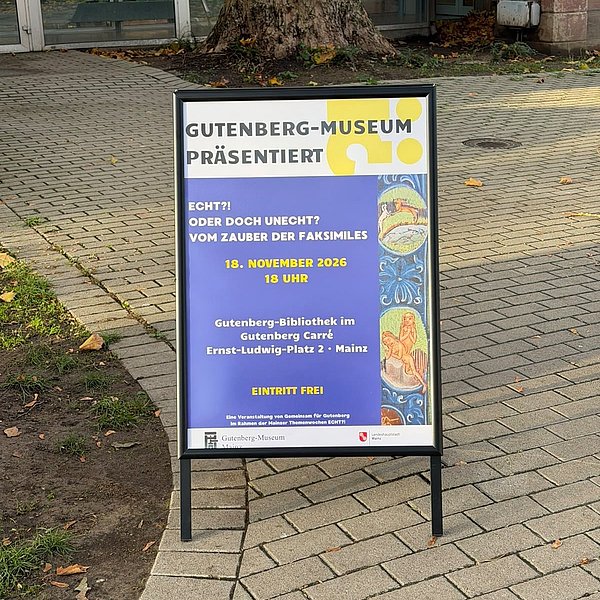
Strong public interest, fascinating insights and lively discussion: on 18 November 2026, the library of the Gutenberg Museum in Mainz became a meeting place for everyone interested in the art of facsimile publishing. Under the title ‘Genuine?! – Or Not? The Fascination of Facsimiles’ („Echt?! – oder doch unecht? Vom Zauber der Faksimiles“), experts discussed the authenticity, production and cultural significance of faithful reproductions of historical manuscripts.
How authentic can a reproduction be? What makes a facsimile so special, and what added value do these meticulously detailed reproductions offer compared with digital reproductions or text-only editions?
These were the questions explored at the event, which formed part of the ‘GENUINE?!’ themed weeks („ECHT?! Themenwochen“) organised by the Academy of the Diocese of Mainz. Experts from the fields of book studies, book art and museum practice came together in the library of the Gutenberg Museum to explore the fascinating world of facsimiles from a range of perspectives.
The event attracted a large audience. The many questions from attendees, in particular, sparked lively discussion and demonstrated the enduring appeal of historical book art and cultural heritage.
Expert Perspectives on Originals and Reproductions
Their different professional perspectives provided a multifaceted insight into the significance and possibilities of faithful reproductions. The discussion went beyond the question of what distinguishes a facsimile from an original, exploring its particular value for scholarship, research and cultural education, as well as its role in making important historical works accessible to a wider audience.
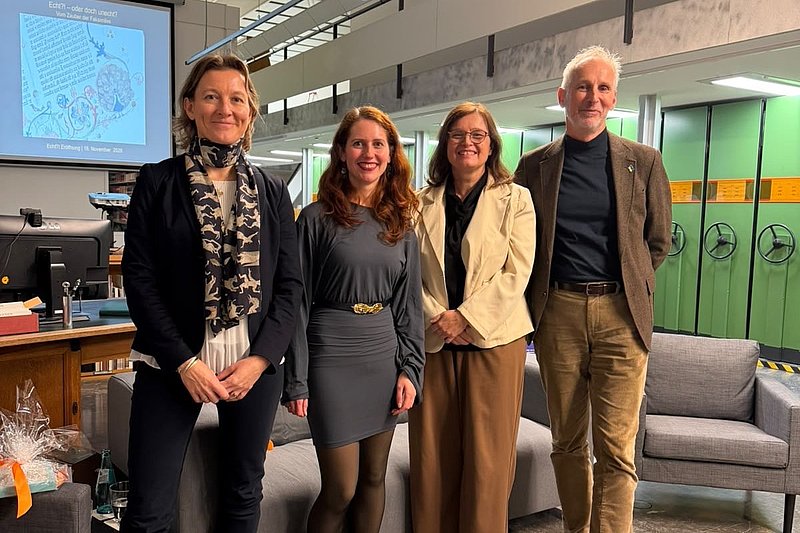
Exchanging expert perspectives: Charlotte Kramer with Prof. Dr Gerhard Lauer, Julia Bangert and Ulla Reske, MA, Curator of the Graphic Art Collection and Head of Collections, during the event ‘Genuine?! – Or Not? The Fascination of Facsimiles’ in Mainz.
Facsimiles: More Than Just Faithful Copies
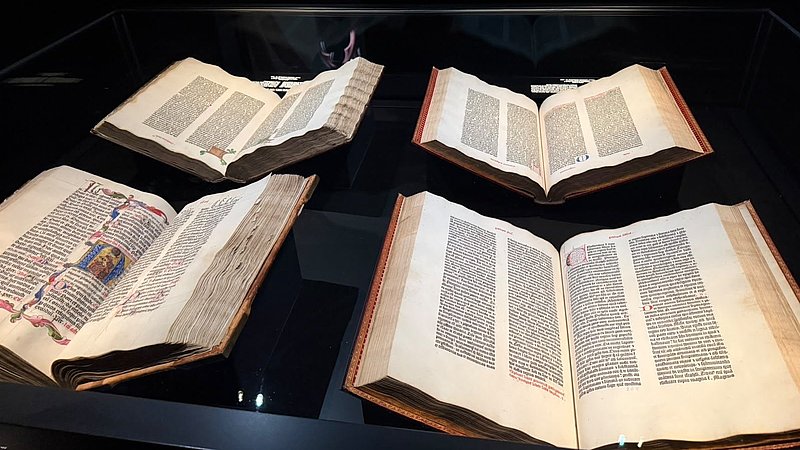
Some of the world's most famous manuscripts and books exist in only one original copy. Anyone wishing to experience them first-hand often has to travel considerable distances. Facsimiles make these unique witnesses to art and cultural history accessible to a much wider audience.
They are far more than mere copies. Their production combines state-of-the-art reproduction technologies with traditional craftsmanship and an exceptional commitment to accuracy. Colours, materials, textures and even the smallest details of the historical originals are reproduced with the utmost care.
This is precisely where their particular value lies: facsimiles allow people to engage directly with historical works without subjecting fragile originals to unnecessary handling. They open up new opportunities for research, education and cultural engagement..
An Evening of Dialogue and Discovery
Alongside the expert contributions, direct interaction with the audience was very much at the heart of the evening. The many questions raised demonstrated the strong interest in the intricacies of facsimile production, the authenticity of reproductions and their importance in preserving our cultural heritage.
The opportunity to experience the facsimiles at first hand also made the evening particularly special. Visitors were actively encouraged to handle and examine the reproductions closely, allowing them to discover the exceptional quality and attention to detail for themselves.
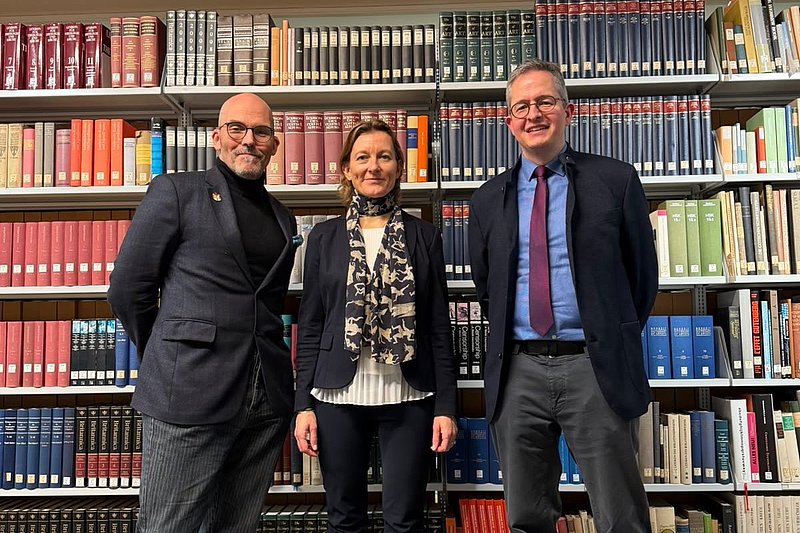
We were particularly delighted to welcome our friend and partner Andrej Pfeiffer-Perkuhn from Geschichtsfenster, who joined us for the event and took the opportunity to meet and exchange ideas in person. A photograph captures him together with Charlotte Kramer, CEO of Universal Art Group, and Dr Marco Brösch, Head of the Gutenberg Library. We were very pleased to have him with us and to share the evening.
A reunion in Mainz: Andrej Pfeiffer-Perkuhn (Geschichtsfenster) with Charlotte Kramer (CEO of Universal Art Group) and Dr Marco Brösch (Head of the Gutenberg Library).
Making Art and Cultural Heritage Accessible
For Universal Art Group and its publishing houses, the event was a wonderful example of how facsimiles can build bridges between the past and the present. They preserve the appearance of unique historical works while opening up new ways for people to engage with art, history and knowledge.
We would like to thank everyone involved, the organisers and all those who attended for an inspiring evening and such stimulating discussions.
Ultimately, the fascination of a facsimile lies not only in preserving the appearance of historical works, but also in making their artistic beauty, historical significance and cultural value tangible for future generations.