
The Unicorn: A Mythical Creature in Art
Between Myth, Symbolism, and Masterpieces of Art History
The Unicorn – A creature that never was, and yet always has been
Few mythical beings have captivated the human imagination as deeply as the unicorn. Whether in natural history, religion, art, or popular culture, the unicorn appears wherever longing meets reality. It is a creature of paradoxes: wild yet chaste, healing yet dangerous, divine yet sensual. Its story stretches across cultures, centuries, and artistic traditions – and remains strikingly relevant today.
From China to the Bible: The origins of the unicorn
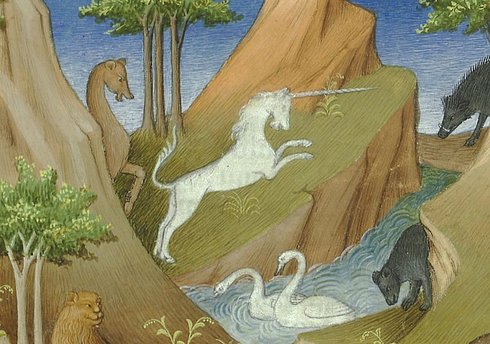
The roots of the unicorn reach further back than many assume. In China, the Chi-lin – a unicorn-like being with dazzling attributes – was already recorded in 2697 BC. Indian legends also describe a solitary, one-horned creature. By the 5th century BC, the Greek physician Ctesias, who lived at the Persian court, brought the unicorn into the Western imagination with his descriptions of a horned animal from India.
Travellers such as Marco Polo, in his famous Le Livre des Merveilles, further embedded the unicorn in European culture. Though his account likely described a rhinoceros, the European image of a graceful, horse-like creature with a long spiralled horn had already taken root.
A mistranslation with consequences: The unicorn in the Bible
Even the Bible features the unicorn – though only due to a mistranslation. The Hebrew word Re’em, probably denoting an aurochs or wild ox, was rendered in Greek and later Latin as Unicornis. This biblical “unicorn” was long accepted as real – a belief that persisted well into the 17th century.
The Unicorn in the Middle Ages: Symbolism and Allegory
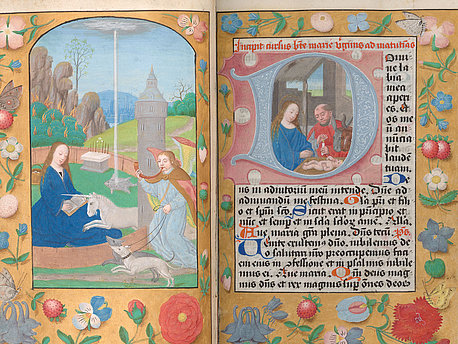
In the Middle Ages, the unicorn became a central motif of Christian iconography. Medieval bestiaries describe it as strong and swift, but tamable only by a virgin. The image of the unicorn resting in a maiden’s lap symbolised the Annunciation and the Passion of Christ – the unicorn as Christ, the virgin as Mary.
Illuminated manuscripts, such as the Peterborough Bestiary, depict this allegory with striking tenderness. The motif soon merged with Marian imagery more broadly. The celebrated theme of the “Unicorn Hunt” was likewise given Christian meaning: the unicorn as Christ, hunted by Gabriel and his hounds named Mercy and Peace.

Einhorn in mittelalterlichen Handschriften
Das Fabeltier erscheint auch in naturkundlichen Kompilationen: Im englischen Manuskript Von Pflanzen und Tieren (Sloane) wird es gleichrangig neben realen Tieren wie Löwe oder Hirsch aufgeführt – ein Beleg, dass das Einhorn im Mittelalter nicht als Fantasie, sondern als Teil der Schöpfung galt.
Das Werk Von wundersamen Begebenheiten zeigt das Einhorn dagegen als erzählerisches Motiv des Staunens und der Wunder. Beide Handschriften unterstreichen, wie eng Glaube, Naturkunde und Fantasie miteinander verbunden waren.
From salvation to commerce: The unicorn’s horn
By the late Middle Ages, the unicorn’s horn had become a precious commodity. In reality, these were narwhal tusks, traded as unicorn horns at extraordinary prices. Considered a universal antidote and aphrodisiac, they were displayed in princely treasuries and apothecaries such as “Zum Einhorn” and remain preserved in collections including the Kunsthistorisches Museum, Vienna.

Duality in medieval art: A creature of extremes
The unicorn’s symbolism was never one-dimensional. In the Stuttgart Psalter, a lion and a unicorn charge furiously at the Crucifixion scene, embodying danger as well as salvation. Such ambivalence reflects the medieval worldview: the unicorn could be pure and perilous, a healer and a threat, a symbol of chastity and desire.
Courtly love and worldly allure
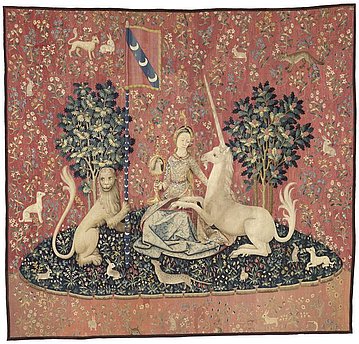
Beyond the religious sphere, the unicorn also became a symbol of courtly love, fidelity, and power. The taming maiden represented the idealised beloved, a fusion of erotic desire and spiritual devotion.
Iconic works such as La Dame à la Licorne (Musée de Cluny, Paris) or The Hunt of the Unicorn tapestries (The Cloisters, New York) show this duality in sumptuous detail. The latter culminates in a striking image: the unicorn, hunted by twelve men, finally captured yet serene, bound to a pomegranate tree amidst a flowering meadow of fertility symbols.
Renaissance reinventions
The unicorn retained its symbolic richness into the Renaissance. In Raphael’s Lady with a Unicorn or Stefan Lochner’s Madonna of the Rose Bower, the creature appears either as a subtle emblem of chastity or as a profound symbol of divine grace. Even the smallest depiction – such as a clasp on the Virgin’s robe – could carry layered meaning.
Conclusion: An enduring myth
From allegories of salvation to the dreams of courtly romance, from narwhal tusks in apothecaries to masterpieces of art, the unicorn has remained a timeless symbol. It has inspired theologians, artists, and rulers alike – and its fascination endures today. As a creature of paradox, the unicorn continues to embody humanity’s deepest desires, fears, and hopes.
Do not miss the exhibition organised by the Museum Barberini, Potsdam, and the Musée de Cluny – Musée national du Moyen Âge, Paris. Unicorn. The Mythical Creature in Art will be on view there from 13 March to 12 July 2026.
At the Museum Barberini in Potsdam, the exhibition will run from 25 October 2025 to 1 February 2026.
https://www.museum-barberini.de/de/ausstellungen/16992/einhorn-das-fabeltier-in-der-kunst
Image sources:
Hunt of the Unicorn Annunciation Ms_g_5_fol18v_a
The Morgan Library & Museum, New York
https://www.themorgan.org/collection/medieval-hunt/128
Stuttgarter Psalter - Cod.bibl.fol.27r
Württembergische Landesbibliothekhttp://digital.wlb-stuttgart.de/sammlungen/sammlungsliste/werksansicht/?id=6&tx_dlf%5Bid%5D=1343&tx_dlf%5Bpage%5D=57
Dame mit Einhorn Cl.10836
Musée de Cluny, Paris
https://www.musee-moyenage.fr/collection/oeuvre/la-dame-a-la-licorne.html
Marco_Polo_Livre_des_merveilles_fol85r_ausschnitt
gallica.bnf.fr / Bibliothèque nationale de France
https://gallica.bnf.fr/ark:/12148/btv1b52000858n/f175.item#
“Jungfrau mit Einhorn” (aus: Bestiarium aus Peterborough) 190v Einhorn
Faksimile Verlag
Bzw. Cambridge, Corpus Christi College, Parker Library, MS 53 (fol.190v)
https://parker.stanford.edu/parker/catalog/gs233db8425


